
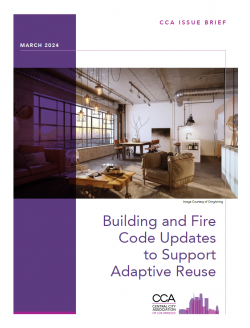
The City’s 1999 Adaptive Reuse Ordinance (ARO), spearheaded by CCA, is credited with breathing new life into DTLA by repurposing obsolete office and bank buildings into 12,000 units of housing, transforming DTLA into a dynamic, 24/7 urban center. In the wake of the pandemic and the diminished demand for office space, CCA is again leading the way on the next wave of adaptive reuse.
This week, we took several big steps on the path needed to make adaptive reuse viable amid current economic conditions and given the design and engineering challenges posed by a large share of office buildings:
1) We published a brief to recommend changes to building and fire codes to support adaptive reuse;
2) Assemblymember Miguel Santiago announced two state bills we're sponsoring to give cities greater flexibility with their building codes and to expand the Mills Act property tax abatement program to provide economic incentives for conversions;
3) We saw the release of the updated Citywide Adaptive Reuse Ordinance by the Department of City Planning that was informed by our 2021 white paper and will greatly expand where adaptive reuse is possible and remove significant barriers to convert buildings; and
4) We hosted an event to showcase progress and attention on adaptive reuse, and convene an expert panel to highlight where we need to go next.
Building and Fire Code Updates to Support Adaptive Reuse
In collaboration with the Los Angeles Department of Building and Safety (LADBS) and Los Angeles Fire Department (LAFD), CCA convened a working group to recommend approaches to building and fire codes that can also support adaptive reuse without compromising public health and safety, in alignment with Mayor Karen Bass’s Executive Directive 7. This work is memorialized in an Issue Brief we released this week, and the recommendations include a host of state and local changes that can 1) expand flexibility for adaptive reuse projects; 2) better enable changes like partial building conversions, rooftop additions and uses; and 3) hone in on important details like elevators, stairwells windows and more. We also recommend the creation of an interdepartmental task force that can quickly address and resolve issues to process projects expeditiously and collaboratively, which was a key driver of success for the 1999 ARO.
The full issue brief with a summary of recommendations can be found here.
The brief also provides an implementation path and timeline to effectuate these changes, first and foremost of which is state action to amend the California Health and Safety Code. We are immediately acting on that recommendation through a partnership with Assemblymember Santiago who has authored AB 2910. This bill would give local jurisdictions the ability to broaden and relax their building codes to support conversions while meeting minimum health and safety standards.
Read the fact sheet for AB 2910 here.
Planning and Land Use Code Changes – Adaptive Reuse Ordinance
On the day we hosted our event “Adaptive Reuse: What’s Next,” the Department of City Planning released the updated draft Citywide Adaptive Reuse Ordinance, which incorporates many of the recommendations in CCA’s 2021 white paper “Adaptive Reuse: Reimagining Our City’s Buildings to Address Our Housing, Economic and Climate Crises.” This includes expanding the program to the whole city, allowing buildings to age into the program by setting a rolling year-built threshold rather than a fixed year, maximizing flexibility for residential unit sizes and configurations, making it easier to provide amenity spaces, enabling new floor area to be added, not requiring new parking and providing by-right approvals for the majority of projects.
We are excited to see this updated ordinance and we are eager for its adoption this year.
Financial Incentives to Close the Feasibility Gap for Conversions
While we’re continuing to make great progress on the regulatory barriers to conversions, we know that a large share of adaptive reuse projects will still face considerable financial feasibility challenges. These projects are complex and costly and there are real macro-level challenges in current economic conditions with high interest rates and real estate transfer taxes imposed by Measure ULA. To address these challenges, we are researching what other cities are doing to provide financial incentives for adaptive reuse, including Calgary, New York City, Atlanta, Chicago, Boston, Washington DC and San Francisco.
We are also looking to proven programs here in LA and the state of California, specifically the Mills Act property tax abatement program. Although the Mills Act is focused on historic preservation, it has naturally dovetailed with historic buildings that have been adaptively reused. We believe there is an opportunity to make it more expressly supportive of adaptive reuse by expanding the kinds of projects that can use it. That is why we’re also working with Assemblymember Santiago on AB 2909 to allow adaptively reused non-historic buildings to use the Mills Act, so long as they are 30 years or older and located in commercial areas.
Read the fact sheet for AB 2909 here.
Working Together to Enact Change
This was a big week for adaptive reuse, but, while we celebrate the progress to date, we must remain focused and united to maintain the momentum. We must continue to build partnerships and convene cross-sectoral discussions with experts and decisionmakers, like the event we held this week, which included:
- Host/Panel Moderator
- Nella McOsker, President and CEO, CCA
- Speakers
- Assemblymember Miguel Santiago
- LA City Councilmember Nithya Raman
- Panel
- Bea Hsu, Principal, BCH Group
- William Lamborn, Director of Planning Policy and Development, Mayor's Office
- Karin Liljegren, Founder + Principal, Omgivning
- Osama Younan, General Manager, LA Department of Building and Safety
- Philip Yu, Principal, Miyamoto International
View a recording of our event here.
We are grateful to this group and all of our members and partners for the work we have accomplished together. As we focus on enacting the laws and policies we have crafted and set in motion together, we will need to show our collective, full-throated support to ensure we successfully reach the finish line.